Your vehicle’s tyres are the only four points of physical contact between your car and the asphalt. Under normal driving conditions with proper wheel alignment and balanced air pressure, tyres should wear down smoothly and symmetrically across their entire circumference. When you discover that why car tyres wear unevenly on the inner edge, outer shoulder, or in scalloped patches, your rubber is visually signaling an underlying mechanical problem. Learning how to read tread wear patterns helps you diagnose suspension wear, improper inflation, and misalignment before facing a dangerous highway blowout.
The Top 5 Tyre Wear Patterns and What They Mean
1. Inner or Outer Shoulder Wear (Camber Misalignment)
If the tread on the inner edge of your tyre is worn completely bald while the outer edge retains deep rubber grooves (or vice versa), your vehicle suffers from camber angle distortion. Camber is the inward or outward tilt of the wheel when viewed from the front of the car.
- Negative Camber (Inner Wear): The top of the tyre tilts inward toward the engine, placing extreme pressure on the inner tread block. This is commonly caused by sagging springs, bent struts, or worn control arm bushings.
- Positive Camber (Outer Wear): The top of the tyre tilts outward, wearing the exterior shoulder rapidly. This often indicates damaged steering knuckles or collision impact damage.
2. Center Tread Baldness (Over-Inflation)
When the center strip of rubber is worn down smooth while both outer shoulders remain thick and healthy, the tyre has been consistently operated with excessive air pressure. Over-inflation balloons the center of the contact patch outward, forcing the middle of the tyre to bear the entire vehicle weight while reducing grip and braking traction.
3. Both Outer Shoulders Worn (Under-Inflation)
If both edges of the tyre tread are scrubbed away while the center remains raised, the tyre has been driven under-inflated. Low pressure causes the center of the tyre to cup upward, transferring vehicle load exclusively to the sidewall shoulders. This creates extreme internal heat buildup that can lead to catastrophic sidewall delamination at highway speeds.
4. Feathered Edges Across Tread Blocks (Toe Misalignment)
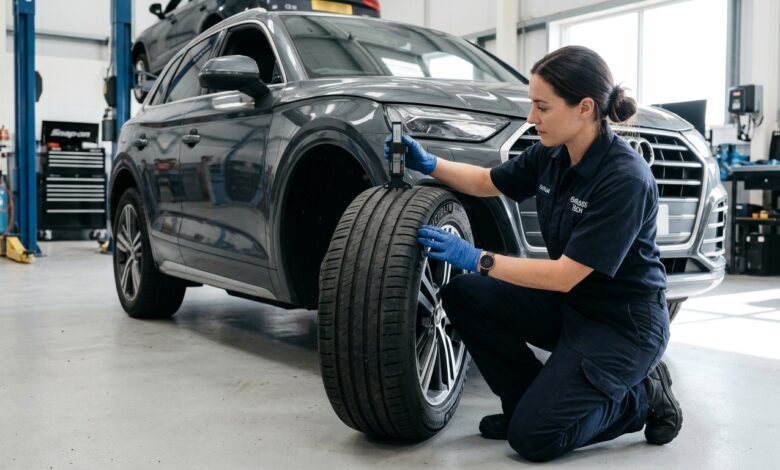
Run your palm smoothly across the tread surface from the inside shoulder to the outside shoulder. If the rubber feels smooth in one direction but catches your fingers with sharp, jagged edges in the other direction, the tyre is feathered. Feathering occurs when your wheels are toe-in or toe-out, effectively causing the tyres to scrub sideways across the road surface rather than rolling forward smoothly.
5. Cupping and Scalloped Dents (Worn Shock Absorbers)
Cupping appears as localized scoops or hollow craters worn into the tread every few inches around the tyre. This distinct pattern occurs when worn shock absorbers or blown struts fail to keep the wheel planted on the pavement. The tyre bounces erratically over road imperfections, slamming down into the asphalt and gouging out rubber sections.
Quick Diagnostic Reference Table
| Visual Wear Pattern | Primary Mechanical Cause | Required Corrective Action |
|---|---|---|
| Heavy inner shoulder scrub | Excessive negative camber | Professional 4-wheel alignment; inspect control arm bushings |
| Heavy outer shoulder scrub | Excessive positive camber | Inspect struts and steering knuckle alignment |
| Smooth bald center strip | Chronic over-inflation | Adjust tyre pressure to driver door placard PSI specification |
| Both shoulders bald, center good | Chronic under-inflation | Inspect for slow leaks; inflate to recommended cold PSI |
| Sharp jagged edges (feathering) | Incorrect toe angle alignment | Adjust tie rod ends on computerized alignment rack |
| Scalloped dips and cupping | Blown shock absorbers / struts | Replace worn suspension shocks and re-balance wheels |
👉 Read Next: Experiencing shaking through the steering wheel alongside tyre wear? Read our in-depth explainer on why your car shakes: wheel balancing vs alignment guide.
For more vehicle maintenance walkthroughs, battery diagnostic guides, and smart automotive care advice, explore our automobiles section.