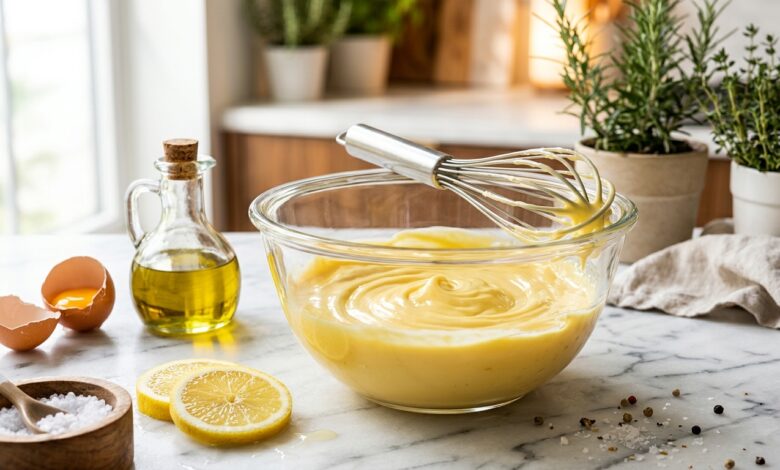
Few kitchen mishaps are as frustrating as watching a bowl of emulsifying mayonnaise suddenly separate into a thin, greasy, curdled yellow liquid. You poured the oil patiently, whisked vigorously, and yet the mixture refused to thicken. If your homemade mayonnaise breaks, do not pour it down the drain. Understanding the simple molecular physics behind oil-in-water emulsions lets you rescue the entire batch in less than two minutes using nothing more than a fresh egg yolk or a teaspoon of warm water.
The Science of Emulsification: Why Separation Happens
Chemically speaking, oil and water are natural enemies. Oil molecules are non-polar and hydrophobic, meaning they naturally repel the water molecules found in vinegar, lemon juice, and egg yolks. Mayonnaise is an emulsion: millions of microscopic fat droplets suspended evenly throughout a tiny water base.
The culinary mediator that holds this fragile peace together is lecithin, a natural phospholipid surfactant present in egg yolk. One end of the lecithin molecule binds to water, while the opposite end binds to fat. Separation occurs when this delicate network is overwhelmed.
1. Pouring Oil Too Rapidly
At the start of blending, the yolk has not yet created a stable suspension matrix. If you pour more than a few drops of oil at a time during the first sixty seconds, free-floating fat droplets collide, merge into larger grease pools, and completely break the emulsion.
2. Cold Refrigerator Ingredients
Using eggs straight from the refrigerator is the most common cause of sudden breaking. Cold egg yolks contain viscous fats that disperse sluggishly, preventing lecithin from coating oil droplets properly. Always bring your eggs, mustard, and lemon juice to room temperature (around 20°C to 22°C) before beginning.
3. Insufficient Water Base
An emulsion requires a continuous water phase to hold the fat droplets apart. As mayonnaise thickens, the ratio of oil to water climbs dramatically. If there is not enough free moisture, the droplets crowd together, collide, and force the oil out of suspension.
The 2-Minute Egg Yolk Rescue Method
This foolproof culinary technique restores broken mayonnaise without diluting its rich flavor profile:
- Start Fresh in a Clean Bowl: Place one room-temperature fresh egg yolk into a clean, dry glass or stainless steel mixing bowl. Add one teaspoon of Dijon mustard and one teaspoon of warm water.
- Whisk the Base: Whisk the fresh yolk and water until pale, frothy, and slightly thickened (about 30 seconds).
- Slowly Introduce the Broken Mixture: Treat your broken, separated mayonnaise exactly like oil. Drizzle it into the fresh yolk drop by drop while whisking continuously.
- Watch the Transformation: Within 45 seconds, the fresh lecithin will capture the suspended fat droplets, turning the oily liquid back into a silky, luxurious, restaurant-grade emulsion.
Quick Troubleshooting Guide
| Symptom | Underlying Cause | Immediate Fix |
|---|---|---|
| Greasy, separated puddles | Oil added too fast | Whisk slowly into a fresh yolk with 1 tsp warm water |
| Curdled, lumpy texture | Cold refrigerator eggs | Warm bowl slightly with hands; add 1 tsp hot tap water |
| Thin, runny consistency | Insufficient oil whisked in | Continue whisking in room-temperature neutral oil in a slow stream |
| Mayonnaise splits in fridge | Freezer hotspot or cold shock | Re-whisk with 1 tsp boiling water before serving |
👉 Read Next: Working with poultry and fresh ingredients? Review our practical kitchen guide on how to tell if chicken is cooked safely to prevent foodborne bacteria and dry meat.
Explore more kitchen science walkthroughs, safe ingredient storage techniques, and foolproof household cooking tips in our food guides section.