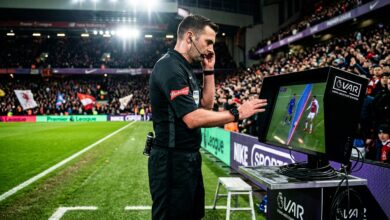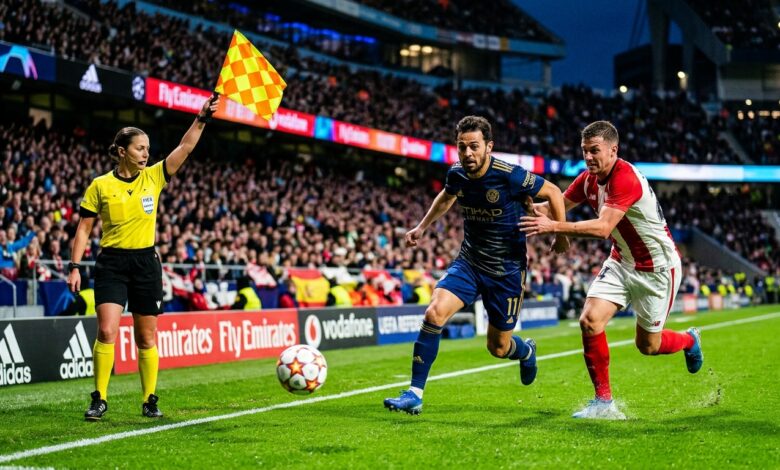
Few refereeing decisions trigger as much heated debate in modern football as offside calls involving players who never actually touched the ball. Under IFAB Law 11, simply standing in an offside position is not an offence. The controversy erupts when match officials and VAR must determine whether an attacker’s movement, positioning, or posture constitutes an active offence. Understanding the football offside rule explained through modern interpretations clarifies how referees judge interfering with play, challenging opponents, and visual obstruction.
Offside Position vs. Offside Offence: The Fundamental Distinction
A player stands in an offside position if any part of their head, body, or feet is nearer to the opponents’ goal line than both the ball and the second-last opponent (the last opponent is almost always the goalkeeper). Crucially, the hands and arms of all players, including goalkeepers, are not considered when calculating offside lines.
Being in this position is completely legal until the ball is played or touched by a teammate. At that precise millisecond of contact, an offside offence is triggered only if the player becomes actively involved in play through one of three specific actions:
- Interfering with play: Playing or touching a ball passed or touched by a teammate.
- Interfering with an opponent: Preventing an opponent from playing the ball by obstructing their vision, challenging for the ball, or physically impacting their ability to play it.
- Gaining an advantage: Playing a ball that rebounds off the goal frame, a match official, or an opponent making an instinctive reflex save.
What Counts as Interfering With an Opponent?
The most scrutinized VAR reviews occur when an offside attacker does not touch the ball, yet influences the goalkeeper’s decision-making. IFAB guidelines break this down into three strict criteria:
1. Preventing an Opponent from Playing or Being Able to Play the Ball
If an attacker in an offside position stands directly in the goalkeeper’s line of vision when a teammate strikes a shot from outside the penalty area, an offside offence must be penalized. Even if the attacker ducks under the ball or attempts to get out of the way, their presence delayed the keeper’s sightline and reaction time.
2. Challenging an Opponent for the Ball
If a forward in an offside position contests a header, makes an aggressive lunging motion toward the ball, or physically nudges a defender tracking back, that contact constitutes active interference. The defender was forced to alter their defensive action due to the offside attacker’s challenge.
3. Clearly Attempting to Play the Ball Close to It
When an attacker makes an overt physical gesture to strike the ball—such as swinging a leg at an incoming cross and narrowly missing—this action directly affects the goalkeeper’s positioning and dive timing. Referees penalize this as a clear impact on the opponent.
The Controversial “Deliberate Play” vs. “Deflection” Rule
A major evolution in Law 11 governs what happens when a defending player touches the ball before it reaches an offside forward. If a defender makes a deliberate play on the ball (such as an intentional clearance or controlled pass), the attacker is no longer penalized for their offside position.
However, if the defender merely performs an instinctive reflex block, a desperation deflection, or a save to prevent an immediate goal, the attacker remains strictly offside. Referees evaluate whether the defender had time to coordinate their body, see the ball approaching, and execute a controlled action.
Summary of Offside Offence Criteria
| Scenario | Attacker Touches Ball? | Referee Decision |
|---|---|---|
| Standing directly in keeper’s line of sight on a long shot | No | Offside (Visual obstruction of opponent) |
| Running toward ball but slowing down before reaching it | No | Onside (Play continues if teammate arrives first) |
| Swinging boot to kick ball and missing by centimeters | No | Offside (Impacts keeper’s dive timing) |
| Scoring from a rebound off the crossbar or goalkeeper save | Yes | Offside (Gaining an advantage from position) |
| Receiving ball after defender’s controlled backpass mistake | Yes | Onside (Deliberate play by defender resets phase) |
👉 Read Next: Want to understand how semi-automated cameras and 3D limb tracking verify these calls? Read our complete technical guide on how VAR works in football.
For more deep-dive rule analyses, cricket pitch aerodynamics, and professional sports breakdown articles, visit our sports coverage hub.