You drive onto an open highway, accelerate past 80 km/h, and suddenly feel your steering wheel trembling in your hands. When a car vibrates at high speed, drivers often wonder whether they need wheel balancing or wheel alignment. While motorists frequently confuse these two common maintenance services, they resolve completely different steering and suspension problems.
Wheel balancing corrects weight distribution around the rotating wheel assembly, whereas wheel alignment calibrates the geometric angles of your suspension system. In this comprehensive comparison, we explain how each service works, highlight their distinct warning signs, and show you exactly how to identify the cause of highway vibration.
What Is Wheel Balancing and How It Works?
No tyre or metal alloy wheel is perfectly symmetrical from the factory. Manufacturing variations, tyre valve stems, and internal rubber seams create tiny heavy spots across the wheel circumference. Even a minute weight discrepancy of just 15 grams generates noticeable centrifugal force when spinning hundreds of times every minute at highway speeds.
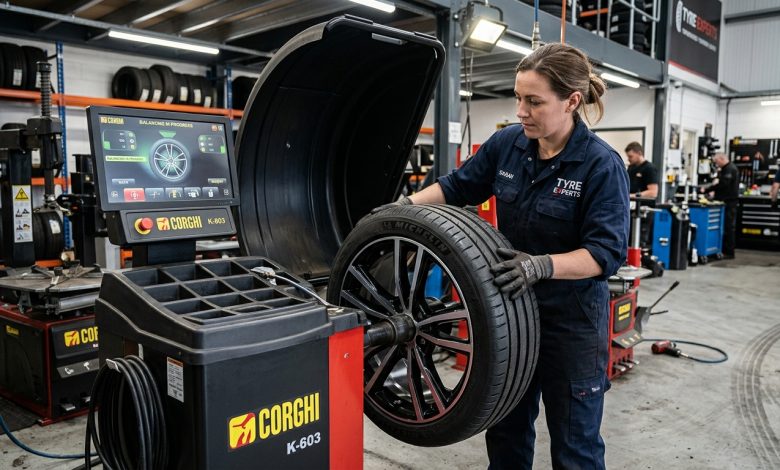
To eliminate this instability, technicians mount your wheel onto an electronic dynamic balancing machine. The machine spins the tyre at simulated highway speeds, using sensitive optical sensors to calculate the exact location and weight imbalance. The technician then attaches precision lead-free clip-on or adhesive counterweights along the wheel rim to counteract the heavy spots.
What Is Wheel Alignment and How It Works?
In contrast, wheel alignment has nothing to do with tyre weights. Instead, alignment adjusts the physical mounting angles of your vehicle suspension components relative to the road surface and vehicle centerline. Technicians adjust three primary suspension geometry angles:
- Camber: The inward or outward vertical tilt of the tyre when viewed from the front of the vehicle. Incorrect camber wears the inner or outer edge of your tread prematurely.
- Toe: The direction the tyres point inward or outward relative to the vehicle longitudinal axis, viewed from above. Improper toe settings create severe diagonal tread scrubbing.
- Caster: The forward or backward angle of the steering pivot axis. Caster provides high-speed directional stability and ensures your steering wheel returns to center naturally after turning.
Balancing vs Alignment: Diagnostic Symptom Comparison
| Vehicle Symptom | Primary Suspect | Recommended Service |
|---|---|---|
| Steering wheel shakes at 80–110 km/h | Front tyre weight imbalance | Front Wheel Balancing |
| Seat or floorboard vibrates at highway speeds | Rear tyre weight imbalance | Rear Wheel Balancing |
| Vehicle drifts or pulls to one side on flat roads | Uneven suspension geometry | Four-Wheel Alignment |
| Steering wheel sits crooked when driving straight | Off-center tie rod adjustment | Wheel Alignment |
| Feathered, saw-tooth, or single-edge tyre wear | Toe or camber misalignment | Wheel Alignment & Rotation |
Step-by-Step Road Test to Diagnose the Cause
To pinpoint the issue on your own vehicle, perform this simple diagnostic road test on a smooth, empty stretch of level asphalt:
- Test for Speed-Specific Vibration: Accelerate smoothly from 60 km/h to 110 km/h. If the shaking begins around 80 km/h, peaks at 100 km/h, and smooths out at higher speeds, you have classic dynamic wheel imbalance.
- Test for Directional Pull: While cruising at 60 km/h on a level lane with zero crosswinds, loosen your grip on the steering wheel slightly. If the car promptly drifts toward the shoulder, suspension alignment is misaligned.
- Inspect Tread With Your Palm: Run your hand across the surface of the front tyres. If the tread feels rough, jagged, or angled in one direction like saw teeth, poor toe alignment is grinding your rubber away.
Keeping both balancing and alignment within factory tolerances prevents premature suspension wear, maximizes fuel efficiency, and protects tyre longevity. For more vehicle maintenance advice, explore our automotive guides.