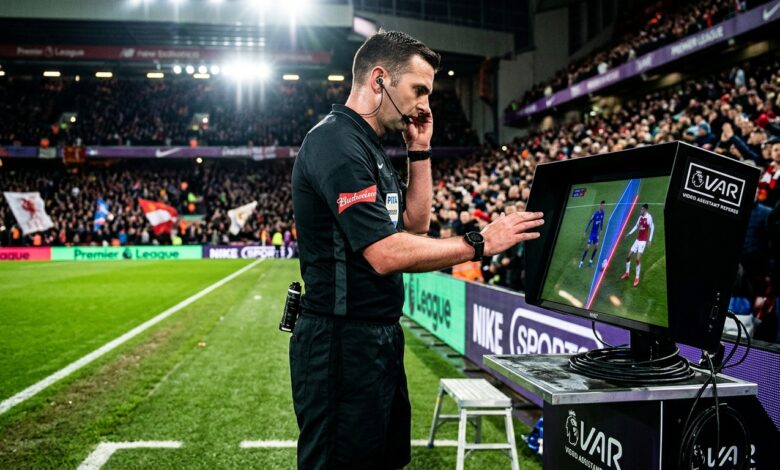
A striker slips past the defensive line, slots the ball into the bottom corner of the net. Launches into a passionate stadium celebration. But before the restart, the referee raises a finger to his ear. Signals a television rectangle with his hands. Jogs over to the touchline monitor. Therefore, understanding how var works in football demystifies the technical and philosophical layers governing modern match officiating.
The Video Assistant Referee (VAR) system was introduced into the Laws of the Game by IFAB. This technology eliminates match-deciding officiating blunders. From controversial red cards to razor-thin offside calls. Video technology has fundamentally altered the tempo and drama of global football. In this comprehensive technical guide, we examine the four reviewable match categories. Explain how calibrated 3D offside lines counteract optical parallax distortion. Detail semi-automated offside technology.
Match Scenarios Explaining How VAR Works in Football
Under strict IFAB protocols, the VAR team does not re-referee the entire match. They work from a video operations room. Video interventions are strictly limited to four specific match-altering scenarios.
- Goal / No Goal Incidents: Verifying whether an attacking team committed a foul. Committed an offside infraction. Officials verify whether the ball crossed the touchline during the attacking buildup to a goal..
- Penalty / No Penalty Decisions: Assessing whether a referee awarded an incorrect penalty kick. Officials review missed fouls inside the box..
- Direct Red Card Incidents: Reviewing severe violent conduct, dangerous tackles, or biting/spitting offenses. Crucially, second yellow cards are never reviewable by VAR.
- Mistaken Identity: Ensuring that disciplinary cards are awarded to the correct offending player. This resolves mistaken identity in skirmishes..
The “Clear and Obvious Error” Standard
The philosophical foundation of VAR relies on a governing principle: “Minimum interference, maximum benefit”..
The Video Assistant Referee will only advise an on-field review if the original decision was a “clear and obvious error”. If an incident involves a subjective 50-50 challenge or borderline physical contact where reasonable referees might disagree. The on-field call is upheld. The touchline pitchside monitor (On-Field Review) is utilized for subjective decisions like foul severity. Factual decisions like penalty boundary lines are communicated directly to the referee via radio..
How Calibrated 3D Offside Lines Counter Parallax Distortion
Offside reviews frequently spark intense debates. Broadcast cameras view the pitch from angled stadium positions rather than perpendicular lines. This geometric discrepancy creates optical parallax distortion, making parallel lines appear slanted.
To eliminate optical distortion, software creates a calibrated 3D grid. This mapping matches pitch dimensions before kickoff. When an offside call is evaluated:
- Frame Synchronization: Operators select the exact video frame where the passer first makes contact with the ball..
- Anatomical Positioning: The system identifies legal scoring body parts. These include the head, chest, knees, and feet.. Excluding hands and arms).
- Vertical 3D Projection: The software drops vertical mathematical lines from players’ bodies down to the grass turf.. Generating two calibrated lines (green for defender, red for attacker). If the red line overlaps or sits ahead of the green line, the player is offside.
Semi-Automated Offside Technology (SAOT) Explained
| Technical Component. | Hardware Specification. | Officiating Function. |
|---|---|---|
| Tracking Cameras. | 10 to 12 synchronized stadium roof cameras. | Tracks 29 anatomical body points per player 50 times/sec. |
| Connected Ball Sensor. | 500Hz inertial measurement unit (IMU) inside ball. | Sends kick-point telemetry 500 times per second. |
| Artificial Intelligence Engine. | Real-time spatial triangulation algorithms. | Calculates offside position within seconds automatically. |
| 3D Animation Generator. | Automated television rendering software. | Generates clear 3D broadcast graphics for fans & referees. |
Semi-Automated Offside Technology (SAOT) cuts review times from several minutes down to under thirty seconds. Delivering objective spatial accuracy to international tournaments. For related sports technology breakdowns, read our in-depth analysis on how Hawk-Eye DRS ball-tracking works in cricket. For more sports features, visit our complete sports journalism archive.