You turn on a blockbuster movie on your modern 4K smart television. During intense action scenes the background music roars with deafening volume while actor dialogue sounds muffled, hollow. Barely audible. Navigating the soundbar vs tv speakers decision is one of the most transformative home entertainment upgrades any viewer can make.
As modern flat-screen televisions have grown impossibly thin with bezel-less glass designs. Physical enclosure space for acoustic speakers has vanished. Consequently, built-in television speakers have deteriorated into small, low-wattage transducers firing downward or backward into your drywall. In this comprehensive audio comparison. We explain why television speakers struggle with vocal clarity, examine soundbar acoustic driver design. Help you determine whether an external soundbar fits your living room budget.
The Physics Problem: Why Modern TV Audio Sounds Thin
To produce rich, full-bodied sound waves (especially lower midrange and bass frequencies), audio drivers require three physical assets. Large speaker cone surface area, robust magnets. Adequate resonant cabinet air volume.
A high-end 65-inch television may measure barely an inch thick. To fit inside this ultra-slim chassis, manufacturers utilize tiny 10-watt oval micro-speakers. Because there is no room on the front bezel. These speakers fire downward toward your media furniture or backward against your living room wall. Sound waves must bounce off furniture and drywall before reaching your ears. Consequently, sound arrives with phase distortion, muddy bass, and muffled vocal intelligibility.
Why Choose a Soundbar vs TV Speakers for Home Theater
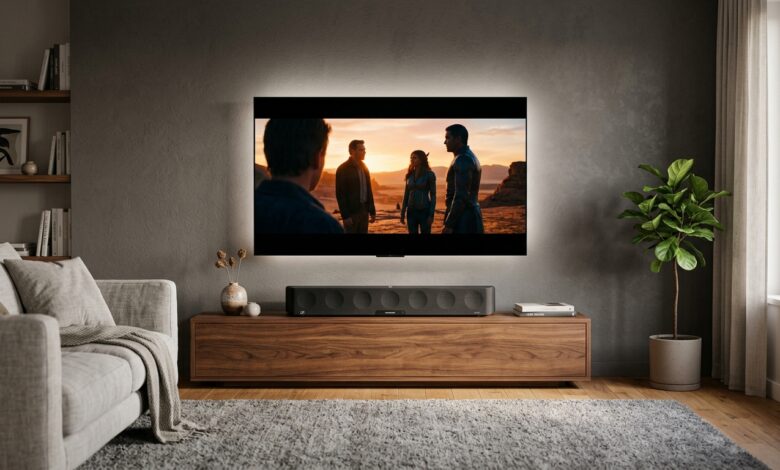
A soundbar is a horizontal enclosure specifically engineered to house an array of dedicated forward-firing acoustic drivers. By pointing drivers directly toward the listener, soundbars provide immediate acoustic benefits:
- Dedicated Center Channel for Dialogue: A standard 2.0 TV speaker setup forces vocal frequencies to share two stereo channels with sound effects. In contrast, 3.1 or 5.1 channel soundbars feature a dedicated central speaker focused solely on speech frequencies (85 Hz to 255 Hz), guaranteeing crystal-clear dialogue.
- External Wireless Subwoofers: Low-frequency bass rumbles require moving large volumes of air. Soundbar packages include dedicated wireless subwoofers with 6-inch to 8-inch woofers. Delivering punchy, cinema-level bass that televisions cannot physically replicate.
- Acoustic Beamforming &. Dolby Atmos: Advanced soundbars incorporate upward-firing and angled side drivers that bounce sound waves off your ceiling and walls. Creating an expansive three-dimensional spatial soundstage.
Acoustic Comparison: Soundbar vs TV Speakers
| Audio Feature. | Built-In TV Speakers. | Dedicated Soundbar System (3.1+). |
|---|---|---|
| Driver Orientation. | Down-firing or rear-firing. | Forward-firing directly toward listeners. |
| Dialogue Clarity. | Muddled & easily drowned out by effects. | Crystal-clear via dedicated center channel. |
| Frequency Range. | 100 Hz to 12,000 Hz (No real bass). | 35 Hz to 20,000 Hz (Deep resonant rumble). |
| Amplifier Power. | 10W to 20W total system power. | 150W to 400W+ dynamic output. |
| Surround Capability. | Simulated stereo width only. | True spatial Dolby Atmos & DTS:X decoding. |
| Connection Setup. | Internal (no cables needed). | Single HDMI eARC cable (CEC volume sync). |
Channel Configurations: What Do 2.1, 3.1, and 5.1 Mean?
When shopping for a soundbar. Understanding audio channel numbering ensures you purchase the right hardware configuration for your space:
- 2.0 / 2.1 Channels: Two front stereo drivers (left and right). The “.1” denotes an external powered subwoofer. A solid budget upgrade for bedroom televisions.
- 3.1 Channels: Three forward channels (Left, Center, Right) plus an external subwoofer. This is the recommended sweet spot for movie lovers, offering an isolated center dialogue channel.
- 5.1.2 Channels: Five surround channels (Left, Center, Right, Left Surround, Right Surround), one subwoofer. Two upward-firing height channels for immersive overhead Dolby Atmos effects.
Connecting your soundbar via HDMI eARC allows you to control power and volume effortlessly with your regular television remote. For related home audio troubleshooting. Read our practical guide on how to fix muffled TV dialogue and sound settings. For more home theater tutorials, explore our full entertainment guides library.