You are standing in front of a wall of televisions and every one of them looks fine. The 43-inch looks sensible. The 65-inch looks like showing off. Then the box comes home, you sit down on your own sofa, and the screen looks smaller than it did in the shop.
Shop lighting is not what fooled you. The number that decides how big a television feels is your TV viewing distance — the gap between your eyes and the screen — and you can measure it with a tape before you spend a rupee.
Measure your TV viewing distance first
Sit where you actually watch. Not the dining chair you drag over for cricket, the seat you use every night. Measure from your head to the wall the TV will sit on, and convert it to inches: feet times twelve.
Now do one multiplication. The home-cinema guide published by Kaleidescape gives two figures, both based on field of view — how much of your vision the screen takes up:
- Distance in inches × 0.65 = a screen for mixed viewing
- Distance in inches × 0.835 = a screen for a cinema-style picture
Their worked example is a sofa seven feet from the wall, which is 84 inches. That gives 84 × 0.65 = a 55-inch screen, or 84 × 0.835 = a 70-inch one.
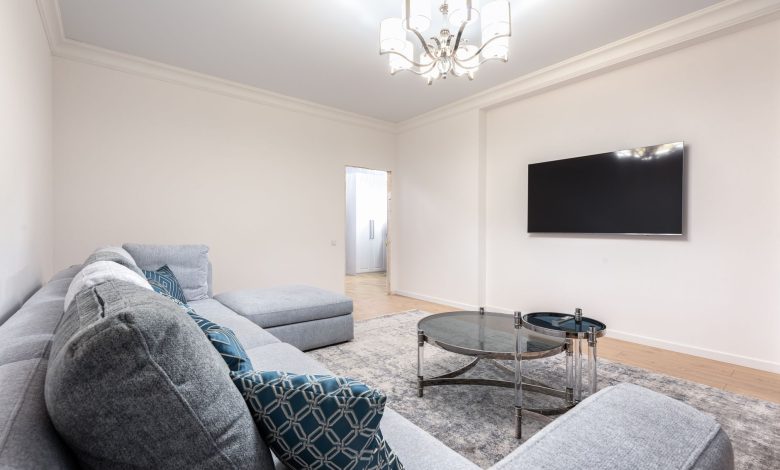
Try it with a more typical Pakistani drawing room, where the seating runs along one wall and the TV sits on the opposite one. Ten feet is 120 inches. The sum lands at 78 inches for mixed viewing and 100 inches for the cinema figure — well past what most people put on that wall.
Why there are two answers, not one
The two multipliers come from two different standards bodies, and they genuinely disagree.
SMPTE, the film and television engineering society, recommends a 30-degree field of view. THX, the cinema certification outfit founded out of Lucasfilm, recommends roughly 40 degrees for an immersive picture. Audioholics puts the gap in plain numbers: from nine feet away, the 30-degree recommendation works out to about a 68-inch screen, and the 40-degree one to about 90 inches.
So nobody is going to hand you a single correct size. The 30-degree number suits a room where the TV is on in the background, people are talking, and someone is scrolling a phone. The 40-degree number assumes you sit down to watch a film and nothing else.
Most households live closer to the first. Use the 0.65 figure as your floor rather than your ceiling — the common mistake is buying below it, not above.
Screen size decides whether 4K is worth paying for
Resolution and TV viewing distance are the same question asked twice. Pixels only matter if they are big enough in your field of view to be seen separately.
The Kaleidescape guide makes this concrete. At that seven-foot distance, a 70-inch screen is where 4K earns its place. The same seven feet with a 55-inch screen puts you on the border between 2K and 4K, where the extra pixels are doing much less for you.
Turn that around and it becomes a buying rule. If you are sitting eleven feet away and choosing between a 43-inch 4K set and a 43-inch 1080p set, resolution is not your limiting factor — the screen is simply too small in your vision for the difference to show. The money is better spent on size.
Get the height right or the size is wasted
A well-sized television mounted too high is still uncomfortable to watch. The mounting guidance from Vogel’s is a single sentence: the centre of the screen should sit at your eye level when you are seated.
In practice that puts the centre of the screen somewhere between 105 and 152 cm from the floor, depending on your sofa and your height. Vogel’s suggests around 100 to 110 cm to screen centre for a 55-inch set, and 100 to 120 cm for a 65-inch.
This is where a lot of Pakistani installations go wrong. The TV goes on the bracket above the cabinet, or above the split AC unit, and everyone watches at a permanent upward tilt. Measure your seated eye level before the drill comes out.
The practical checks before you pay
A few things the viewing-distance sum will not tell you.
The route into the room. Measure the doorway, the stairwell turn and the lift. A 75-inch box is wider than many flat entrances, and the shop’s delivery team will not solve that for you.
The window. A screen facing an uncovered window will look washed out through the afternoon whatever its size. If that is your wall, curtains will do more for the picture than four extra inches of diagonal.
Your backup supply. Bigger panels draw more power. If the TV runs off a UPS or an inverter through load-shedding, read the wattage printed on the set’s own rating label and check it against what your backup is rated to carry, rather than assuming the new one behaves like the old one.
The stand. If it is not going on the wall, the cabinet has to be wider than the TV’s feet, which on many models sit near the far corners rather than in the middle.
When the new set looks wrong
Get the size and height right and there is still one surprise waiting. Films on a new television often look oddly smooth and cheap, like a studio recording rather than cinema. That is motion smoothing switched on by default, not a fault and nothing to do with your TV viewing distance — our guide to the soap opera effect covers how to turn it off.
The tape measure is the part people skip. Walk to your sofa, measure to the wall, multiply by 0.65, and you will arrive at the shop already knowing which sets are too small to bother with.
Photo by Max Vakhtbovych on Pexels