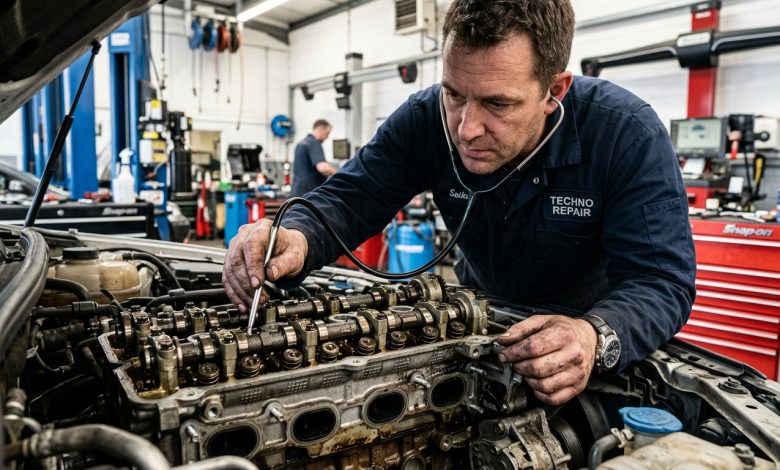
You turn your car ignition key, and an unexpected metallic rhythm echoes from beneath the hood. Distinguishing between engine knocking vs tapping is one of the most critical diagnostic skills any driver can learn. While a light tapping noise often points to minor valvetrain adjustment needs, a deep metallic knocking sound can signal catastrophic internal engine failure.
Understanding where these sounds originate, how their frequencies change with engine speed, and what mechanical components cause them will help you make smart repair choices before expensive engine damage occurs. In this guide, we break down the vital differences between engine tapping and destructive knocking.
Understanding Engine Tapping and Valvetrain Ticks
Engine tapping is typically a light, rapid, metallic click that sounds similar to a sewing machine or a ballpoint pen clicking rhythmically. These sounds almost always originate in the top section of the motor, known as the cylinder head and valvetrain assembly.
Crucially, because camshafts rotate at exactly half the speed of the crankshaft, valvetrain tapping operates at half-engine speed. For example, if your engine idles at 800 RPM, a sticky hydraulic lifter taps approximately 400 times per minute. Common causes of valvetrain tapping include:
- Hydraulic Lifter Bleed-Down: Lifters rely on pressurized engine oil to maintain zero valve clearance. Low oil levels or sludge accumulation causes lifters to collapse, resulting in a persistent top-end tick.
- High-Pressure Fuel Injectors: Modern direct-injection (GDI) systems operate at over 2,000 PSI. The rapid pulsing of direct fuel injectors creates a sharp, rhythmic ticking that is completely normal.
- Exhaust Manifold Leaks: A cracked exhaust manifold or blown flange gasket emits a sharp puffing tick that sounds remarkably like a valvetrain tap, but typically fades as metal expands with heat.
Understanding Destructive Engine Knocking
Unlike light tapping, genuine engine knocking is a heavy, deep, hollow metallic thud that resonates through the lower engine block. Knocking generally falls into two distinct categories:
- Rod Knock (Bearing Failure): Connecting rod bearings sit between the crankshaft journals and connecting rods. If oil starvation or contaminated oil strips the microscopic bearing clearance, metal-on-metal contact occurs. Every combustion stroke hammers the loose rod directly against the crankshaft, producing a violent, heavy knock that intensifies under load.
- Combustion Detonation (Piston Knock): Also called spark knock or pinging, detonation happens when fuel-air mixture explodes prematurely rather than burning in a smooth flame front. Low octane gasoline, extreme carbon buildup, or severe overheating causes uncontrolled secondary explosions that hammer the piston crowns.
Diagnostic Comparison: Tapping vs Knocking
| Diagnostic Factor | Valvetrain Tapping | Connecting Rod Knock |
|---|---|---|
| Acoustic Pitch | High-pitched clicking or ticking | Deep, hollow, heavy metallic thud |
| Location on Engine | Top end (cylinder head & valve cover) | Bottom end (oil pan & engine block) |
| Rhythm & Speed | Half-engine rotational speed (1x per 2 revs) | Full-engine rotational speed (1x per 1 rev) |
| Reaction to Load | Stays relatively constant when revving | Becomes significantly louder under acceleration |
| Immediate Danger Level | Moderate; safe to drive home carefully | Critical; shut engine off immediately |
Simple Troubleshooting Steps to Isolate the Noise
If your engine develops an unfamiliar sound, follow these step-by-step diagnostic procedures before driving to a repair garage:
- Check Oil Level and Condition: Pull your engine dipstick immediately. Extremely low oil levels starve hydraulic lifters and rod bearings alike. If the oil appears milky or contains tiny glittering brass flakes, bearing failure has started.
- Perform the Screwdriver Stethoscope Test: Place the metal blade of a long screwdriver firmly against various engine metal surfaces, and press your ear to the plastic handle. If the sound is loudest on the valve cover, it is a valvetrain lifter. If loudest near the oil pan, it is a connecting rod bearing.
- Rev Engine Gently in Neutral: Lightly press the throttle to 2,000 RPM and release. If a loud rattle peaks right as you release the accelerator, worn connecting rod bearings are loose.
Never ignore a deep engine knock. Shutting down the motor promptly can save your engine block and crankshaft from catastrophic destruction. For more vehicle troubleshooting guides, check our automotive technical guides.