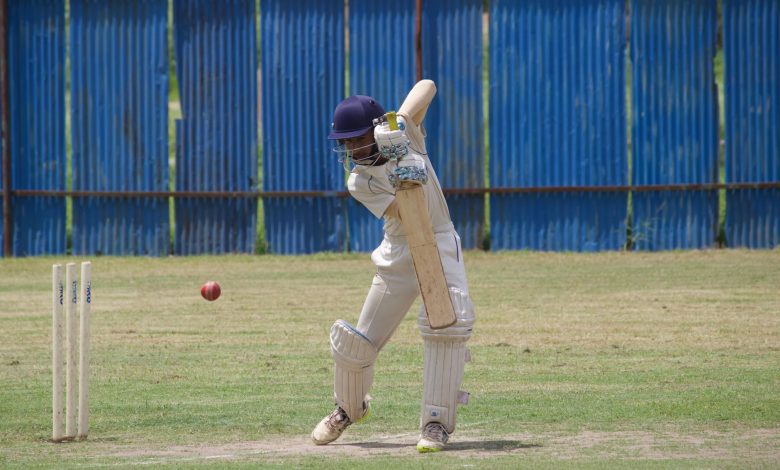
You are at the counter with two bats in your hands. One is Kashmir willow, feels solid, costs what you budgeted. The other is English willow, has a grade sticker near the shoulder, and costs several times more. The shopkeeper tells you the expensive one has a bigger middle. At that moment, choosing a cricket bat is mostly guesswork — unless you know which two or three things actually decide whether you score runs with it.
Most of them you can test yourself, in the shop, in five minutes.
Choosing a cricket bat starts with pickup, not price
The number stamped on the back is dead weight — what the bat weighs on a scale. Pickup is different: it is how heavy the bat feels while you are swinging it. Two bats that weigh the same can have completely different pickup, because it depends on where the wood sits along the blade and how the handle is balanced.
Test it like this. Hold the bat at the very top of the handle with your top hand only, and play ten slow shadow drives. Then pick it up in your stance and hold the bat up, off the ground, for twenty seconds. If the toe starts sinking, or your forearms are complaining by the eighth drive, the bat is too heavy for you — whatever the scale says.
A heavier blade puts more mass behind the ball, but it costs you bat speed and, more importantly, the ability to change your mind halfway through a shot. Against a ball that swings late, being able to adjust matters far more than an extra two ounces of willow.
Get the size right before anything else
Length is what people get wrong most often, usually by buying a junior one size up to grow into. A bat that is too long makes the player reach for the ball instead of getting to the pitch of it, and that habit outlives the bat.
Junior cricket bats run through numbered sizes up to size 6, then Harrow, then full adult sizes. The honest test is a net session, not a shop floor: if you can play a forward defensive with the bat vertical and the toe flat on the ground, the length is right. If the toe lifts or the hands feel jammed, it is not.
The upper limit is fixed by the Laws. A bat may not be more than 38 inches (96.52 cm) long overall, and except for sizes 6 and below, the handle may not exceed 52 per cent of that total length.
English willow, Kashmir willow, and the argument nobody wins
Both cricket bats on that counter are willow, grown in different climates. The broad agreement is that Kashmir willow is denser and harder, and English willow softer and more fibrous. Beyond that the sellers themselves disagree, and you should know that before paying a premium.
One British retailer argues the performance gap is largely a myth — that a well-found middle on a Kashmir bat sends the ball just as far, and that the denser wood survives more seasons. Another takes the opposite view, describing English willow as giving better rebound and easier stroke play, with Kashmir willow suited to practice, matting and school cricket. Both sell bats, so read both with that in mind.
Practically: if you play tapeball, or hard-ball cricket on matting and rough club surfaces, the harder and cheaper blade is a defensible choice. If you bat every weekend on decent turf, test the difference with your own hands rather than taking it on trust.
The same caution applies to grades. Grading systems are set by the brands, not by any governing body, and there is no cross-brand standard — a Grade 2 from one maker is not a Grade 2 from another.
What the Laws actually limit
This matters because shops sell cricket bats that do not comply, and in a formal match that is your problem, not theirs. Under Law 5 of the Laws of Cricket, the blade may not exceed 4.25 inches (10.8 cm) in width, 2.64 inches (6.7 cm) in depth, or 1.56 inches (4.0 cm) at the edges. The blade must be made solely of wood, and the handle principally of cane or wood.
The limits extend to what you stick on afterwards. Protective material covering the face may not exceed 0.04 inches (0.1 cm) thick, and a toe guard may not exceed 0.12 inches (0.3 cm). So an anti-scuff sheet is fine; layering two of them is not.
If you are buying for club or league cricket, ask which bat type it conforms to. Type A bats may be used at any level.
Knocking in is where new bats get wasted
A new cricket bat is not ready to face a hard ball. Knocking in compresses the fibres at the surface so the blade can take impact without cracking, and skipping it is the fastest way to ruin a bat you saved for.
Gray-Nicolls, which makes bats, describes the method plainly: use a proper bat mallet — an old ball in a sock works but is far less consistent — start lightly on the face and build up the force gradually. Work the edges by striking at roughly 45 degrees, mimicking how the ball actually hits them. Do not hammer the edges square on, and keep the mallet off the toe, the back, and the area above the splice.
The useful part is the stopping rule: you are done when the mallet stops leaving marks in the face.
Keeping it alive through a Pakistani summer
Heat and moisture swings damage a cricket bat more than any bowler will. The manufacturer’s care advice is to keep the bat indoors in a cool, dry place, and specifically warns against a car boot, a shed, or anywhere near a radiator. A kit bag left in a locked car through a June afternoon in Karachi or Multan is exactly that scenario.
Oiling is a light coat of linseed oil, applied thinly to the face and edges, avoiding the splice, with the excess wiped off after it has sat overnight. Over-oiling is a real risk — too much softens the willow and costs you performance. If the bat gets wet, let it dry naturally before it goes back in the bag.
So before you hand over the money: take the bat, hold it at the top of the handle, and play those ten drives. If the toe drags, ask for one four ounces lighter — and ignore the grade on the shoulder while you do it.