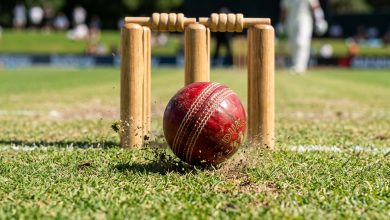
A new ball arcs late towards the slips and the commentators start talking about
conditions. Twenty overs later the same bowler is getting nothing at all, and
then somewhere after the thirtieth over the ball starts moving again — the other
way. If you have never had it explained, swing looks like weather.
It is not. It is a very small amount of aerodynamics that any viewer can learn
to read.
One side smooth, one side rough
A cricket ball has a raised seam running around it, and — crucially — a
fielding side that spends the entire innings polishing one half of it on their
trousers while leaving the other half alone.
Air flowing over the smooth side behaves differently from air flowing over the
rough side. On one side it stays attached to the surface for longer before
breaking away; on the other it separates earlier. Because the air is peeling
off the two sides at different points, the ball is pushed sideways in flight.
That sideways push is swing.
This is why the shine matters so much, and why you see fielders working on the
ball between every delivery. They are not fidgeting. They are maintaining the
asymmetry that makes the whole thing work.
The seam does the aiming
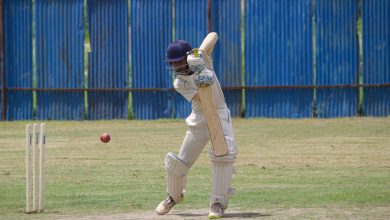
The bowler controls direction by angling the seam. Point the seam towards the
slips and the ball tends to move away from a right-handed batter — an
outswinger. Angle it towards fine leg and it comes back in. The wrist has to
stay firm behind the ball, because a collapsing wrist lets the seam wobble, and
a wobbling seam gives the air no consistent edge to work with.
A few things have to hold together at once: the seam angled and stable, the
shine on the correct side, and enough pace to keep the airflow in the right
regime. Miss any one of them and the ball just goes straight, which is why
bowlers who swing it beautifully in one spell look ordinary in the next.
Why it stops
The reason swing dries up after the opening overs is simply that the difference
between the two sides shrinks. Every bounce on a hard, dry pitch scuffs the ball.
Every shot roughens it further. Eventually both halves are worn, the airflow
behaves much the same over each, and the sideways push disappears.
This is also why you hear so much about conditions. An abrasive, dry surface
tears the shine off quickly. A lush outfield is kinder to the ball. Overhead
cloud is traditionally believed to help swing, and you will hear it stated as
fact in every commentary box — the honest position is that the evidence for a
humidity effect is mixed, and much of what looks like weather may be the pitch,
the ball, and the bowler.
Reverse swing: the same idea, inverted
Then there is the phenomenon that came out of Pakistan in the 1970s and 1980s,
developed by bowlers including Sarfraz Nawaz and popularised by Imran Khan
before Wasim Akram and Waqar Younis made it famous.
With a genuinely old ball, the fielding side stops trying to keep one side
glossy and instead works to keep one side dry and the other heavier with
moisture and wear. At high pace, an old, asymmetric ball starts moving in the
opposite direction to what the seam position suggests. A ball angled as if it
will leave the right-hander instead ducks sharply back into the pads — which is
why reverse swing takes so many wickets leg before and yorks so many batters who
were playing for the other direction.
Two conditions tend to go with it: real pace, and a dry, abrasive pitch that
ages the ball quickly. Those conditions are common across South Asia, which is
no coincidence at all in terms of where the art was developed.
What to watch for on television
Once you know what is happening, the broadcast gives you plenty:
- Which side is shiny. Close-ups between overs show you which half is being
polished. That tells you which way the bowler is trying to move it. - The seam at release. Super-slow-motion replays show the seam angle
clearly. Compare it against which way the ball actually moved. - The slip cordon. Captains do not set fields on a hunch. Three slips and a
gully means someone expects the ball to leave the bat. - The over count. Movement in the first ten overs is conventional swing.
Movement after thirty, going the unexpected way, is reverse. - Who is holding the ball between deliveries. Sides have specialists whose
job is looking after it, and they are not chosen at random.
The part that makes it a skill
All of this can be described in a few hundred words, which makes it sound
straightforward. It is not. The bowler has to reproduce a seam angle, a wrist
position and a release point to within a few degrees, at speed, six times an
over, for hours, while a batter actively tries to disrupt the rhythm — and the
ball they are doing it with changes character every single over.
That is the thing worth appreciating next time a delivery curves late and takes
the top of off stump. Nothing about it was an accident, and nothing about it was
the weather.
Photo by Rising Studio 07 on Pexels