You are driving smoothly down a straight road. The steering wheel sits level, and the car tracks straight. But the moment you press the brake pedal to slow down, the steering wheel jerks to one side and the entire car veers aggressively toward the left or right shoulder. You instinctively fight the wheel to keep the vehicle in its lane.
When a car pulls to one side when braking, it is not merely an annoying alignment problem—it is a critical mechanical safety hazard. Under normal operation, your vehicle’s braking system applies equal hydraulic clamping force to both front wheels. When that symmetry breaks, the side with greater friction pulls the vehicle toward itself.
Here is what causes uneven braking force and how to systematically inspect the problem before replacing parts.
1. Sticking or Seized Brake Caliper Piston
The most common cause of directional brake pull is a seized brake caliper.
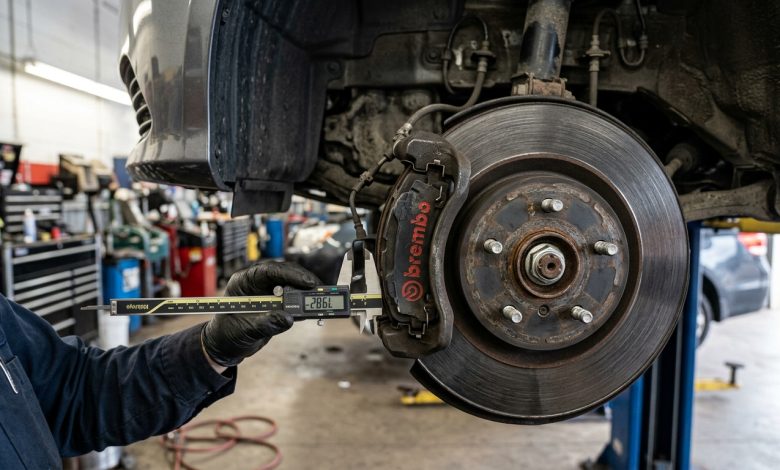
Disc brake calipers feature hydraulic pistons sealed with rubber dust boots. Over years of driving in dusty, humid environments, moisture penetrates the rubber boot, causing internal corrosion and rust on the steel piston wall. Alternatively, the metal slide pins that allow the caliper to center itself seize up from dried grease.
How it behaves:
- If the left caliper piston is stuck frozen and cannot extend, only the right brake grabs the rotor. The car immediately veers violently to the right under braking.
- Conversely, if a caliper extends under hydraulic pressure but fails to retract (dragging brake), the car will constantly drag to that side, and that wheel hub will feel noticeably hot to the touch after driving.
The Touch Test: After a short 15-minute drive, park safely and carefully hold the back of your hand near each front wheel alloy (do not touch the bare rotor directly). If one wheel emits intense radiant heat or a burning friction smell, that caliper is sticking.
2. A Collapsed Flexible Brake Hose
Between your vehicle’s rigid steel brake lines and the moving suspension knuckle sits a flexible reinforced rubber brake hose. While the outside of the rubber hose may appear completely healthy and crack-free, the internal synthetic lining can degrade and delaminate with age.
A deteriorated internal rubber flap acts like a one-way check valve: when you press the brake pedal, intense master cylinder pressure (over 1,000 PSI) forces fluid past the flap to apply the brake. But when you release the pedal, low return pressure cannot overcome the flap, trapping fluid in the caliper. This causes severe dragging and pulling.
3. Uneven Tyre Pressure or Tread Mismatch
Before disassembling expensive hydraulic brakes, always check your tyres. Braking friction happens between the rubber contact patch and the asphalt.
If your front left tyre is sitting at 22 PSI while your front right tyre is properly inflated to 32 PSI, the underinflated tyre has a significantly larger, softer contact footprint and higher rolling resistance. When you hit the brakes, the underinflated tyre drags harder on the pavement, pulling the steering wheel in its direction.
Always verify cold tyre pressures using a reliable digital gauge. For more on checking rubber safety and age, read our guide on reading tyre manufacturing dates.
4. Worn Suspension Control Arm Bushings
If the braking hydraulics and tyres are in perfect condition, the fault often lies in the suspension geometry. Your front wheels are held in place by lower control arms mounted with heavy rubber bushings.
When you brake hard, vehicle weight shifts forward, pushing the front suspension backward under deceleration force. If the rubber bushing on one lower control arm is torn or completely rotted away, that wheel shifts backward by several millimeters during braking. This alters the wheel’s toe alignment dynamically, steering the car abruptly toward the side with the damaged bushing.
Summary: What to Do First
- Equalize tyre pressures: Check and inflate both front tyres to factory specification.
- Perform the heat check: Detect if one wheel rim is substantially hotter than the other after driving.
- Inspect brake pads: Remove both front wheels and check if inner and outer brake pads on both sides have worn down evenly. Uneven pad thickness between left and right wheels confirms a hydraulic or caliper slide issue.