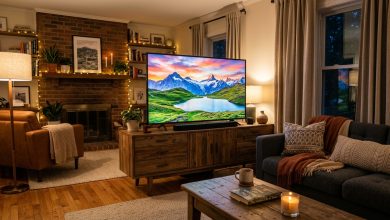
The power comes back after an outage. The fan restarts, the lights steady themselves, and the TV does not wake up. No standby light, no click, nothing. Screens usually die in the moment electricity returns rather than while it is off, and a proper surge protector for TV and audio gear is the cheapest thing standing between your set and that moment.
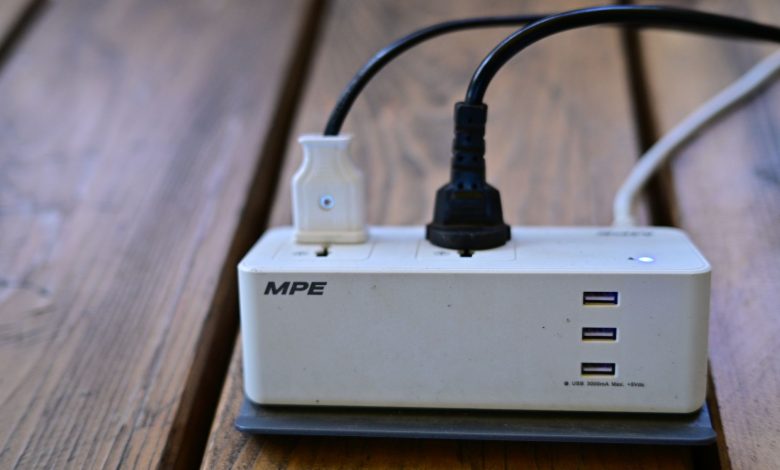
Most people plug a television into whichever multi-socket board was already on the floor. That board is not protection. The Electrical Safety Foundation International is blunt about it: fuses, breakers, house wiring, cheap uninterruptible power supplies and typical power strips do not guard against surges — only a surge protective device does.
What a surge protector for TV gear actually does
Inside a real unit sit metal-oxide varistors, or MOVs. Most of the time they do nothing at all. When line voltage jumps past their threshold, they suddenly conduct and divert that excess energy away from whatever is plugged in.
MOVs typically hold voltage down to around three or four times the normal circuit voltage, not to zero. The aim is survival, not perfection.
Speed is rarely the issue. A spike takes a few microseconds to reach its peak, while MOVs react in nanoseconds. Packaging that shouts about response time is selling you something every device already has.
What it cannot do matters just as much. A transient suppressor is built for spikes lasting microseconds. A sustained overvoltage — the kind lasting seconds, minutes or hours after a transformer fault — is a different problem, and this is not the device for it. Nor will one stop a direct lightning strike on the line; it handles the transients a nearby strike pushes into the grid.
Joules tell you how much abuse it can absorb
The joule rating is the total energy the protector can soak up before it is spent. Think of it as a tank that drains, not a shield that holds.
Tripp Lite’s buying guidance puts basic appliances at 200 to 400 joules and recommends at least 1,000 joules for computers, displays and audio-video equipment. A television, a soundbar and a streaming stick sharing one board sit squarely in that second group. Below 1,000 joules, you have bought an extension lead with a sticker on it.
Be sceptical of enormous numbers printed on unbranded boards. A joule figure means very little when the manufacturer will not name the safety standard the unit was tested against.
Clamping voltage, and comparing numbers honestly
Clamping voltage — also called let-through voltage — is how much voltage still reaches your TV after the protector has done its work. Lower is better. Under UL 1449, the American standard, the acceptable let-through levels are 330, 400, 500 and 600 volts, and 330 is the best of them.
One catch matters a great deal here. Those figures are measured against a 120-volt supply. Your wall socket runs at roughly double that, so a device designed for a 230-volt system will quote a higher number and may still be the better buy. Compare products tested to the same standard at the same mains voltage, or the comparison tells you nothing. When the box names no standard at all, treat the rating as decoration.
There is a quieter trade-off too. A very low clamping voltage means the MOVs step in more often, which can shorten the unit’s working life. That is not a reason to buy a loose one. It is a reason to stop expecting any protector to last forever.
It wears out, and it will not tell you
This is the part almost nobody acts on. Every time an MOV clamps a spike, its threshold drops a little. It can be destroyed by one overwhelming surge or ground down by years of small ones. Eventually the threshold falls close to normal mains voltage, and at that point the device itself can overheat.
Meanwhile the sockets still work. Your TV still switches on. The protection is gone and nothing visible has changed.
That is why the single most useful feature is a protection-status indicator light. If the LED is out, what you own is now a power strip and needs replacing. Some models add an audible alarm. A surge protector for TV use with no indicator at all leaves you guessing, so skip those.
Spikes are not the only way a television dies
If your supply sags instead of spiking — lights dimming when the air conditioner kicks in, a picture that flickers or shrinks — that is a brownout, and surge protection does nothing for it. ESFI warns that brownouts can damage insulation and trigger electronic failures later, and that sustained low voltage is hard on the motors in fridges, air conditioners, washing machines and fans.
Two different tools cover that gap. A voltage stabiliser pushes the supply back up or down toward normal, which is what you want where voltage drifts all day. A UPS carries the load on battery through the dip and gives the TV clean power until it can shut down properly; ESFI recommends battery backup for sensitive electronics. Neither one replaces surge protection. Many homes end up with a stabiliser or UPS on the line and a surge protector between that and the screen.
What to check this week
Start with whatever your TV is plugged into right now. If it has no joule rating printed on it and no status light, it is an extension board pretending.
Then work through the rest:
- Buy point-of-use protection rated around 1,000 joules or more for the TV, soundbar and streaming box, from a brand that names its test standard.
- Use the protected sockets, not the pass-through ones. Some boards mix the two and label them in tiny print.
- Cover the signal path as well. A surge can arrive down a cable or antenna lead as easily as through the mains.
- Unplug during a long outage. Nothing beats an air gap at the moment supply returns.
- Write the purchase date on the underside with a marker. Where spikes are frequent, treat the unit as a consumable.
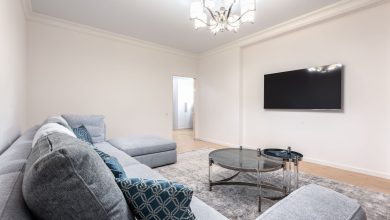
If you are setting up a new television anyway, settle the power side before you start fiddling with picture modes — and get the screen size right for your room while you are at it. A perfectly calibrated TV is still a dead TV when the supply takes it out.
Photo by Sóc Năng Động on Pexels