You glance down at your instrument cluster while sitting in stop-and-go evening rush hour, and your heart skips a beat. The engine temperature needle—which normally sits dead-center—is creeping into the red zone. The radiator warning light blinks on, and a faint sweet smell of steaming coolant fills the cabin.
An overheating engine is an automotive emergency. While minor oil leaks or suspension squeaks can wait until the weekend, severe engine overheating can warp an aluminum cylinder head or blow a head gasket in less than five minutes of redline operation. For more on diagnosing metallic sounds caused by overheating, see what engine knocking and tapping sounds mean.
If your car only overheats when idling or stopped in traffic, but cools down when cruising at speed, here is how to distinguish between a bad radiator fan, a stuck thermostat, and coolant pressure loss.
The Classic Clue: Stopped vs. Moving
The speed at which your car overheats tells you almost everything you need to know about the failure point:
- Overheats ONLY in traffic or at idle: Airflow problem. The cooling fan is not spinning, or the radiator fins are severely clogged with dirt. When the car moves at 60 km/h, ram air cools the engine effortlessly. We covered how this exact issue affects cabin cooling in why car AC blows warm air at idle.
- Overheats at ALL speeds (even on the open highway): Coolant circulation problem. The thermostat is stuck closed, the water pump impeller has disintegrated, or the coolant level is critically low.
1. The Radiator Cooling Fan Motor or Relay
At an idle, there is zero natural wind rushing into the engine bay. The electric cooling fan is solely responsible for pulling outside air through the radiator core.
If the fan motor’s internal carbon brushes are worn out, the fuse is blown, or the coolant temperature switch fails to signal the fan to engage, coolant inside the radiator boils over rapidly. Turning on the car’s AC should immediately force the cooling fan into high gear; if neither fan spins, the fan circuit has failed.
2. A Stuck Thermostat Valve
The thermostat is a temperature-sensitive spring valve containing a wax pellet. When the engine is cold, the valve stays closed to help the engine reach operating temperature quickly. Once coolant reaches roughly 82°C to 90°C, the wax melts, expanding against the spring and opening the valve to let coolant circulate through the radiator.
If the thermostat gets mechanically stuck closed, coolant remains trapped inside the engine block, completely unable to reach the front radiator to shed heat.
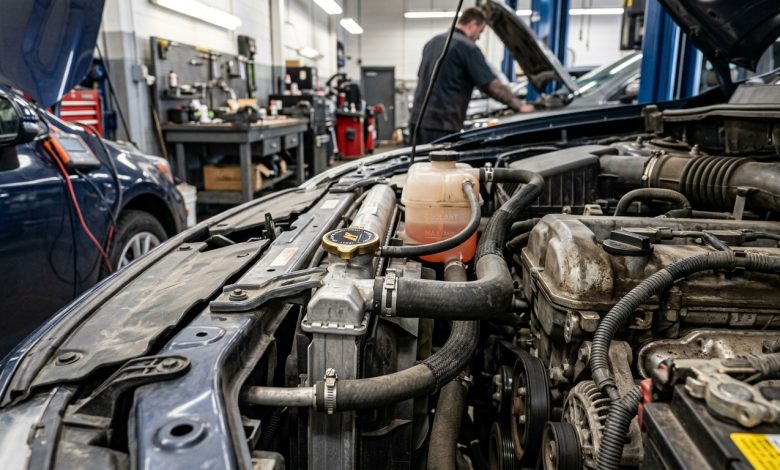
How to test: Carefully feel the upper and lower radiator hoses with your hand (wearing protective gloves). If the upper hose is scalding hot while the lower return hose is cold to the touch with the engine overheating, coolant is not circulating—confirming a stuck closed thermostat.
3. A Weak Radiator Cap (Pressure Loss)
Water boils at 100°C (212°F) at sea-level atmospheric pressure. Modern engines operate at 95°C to 105°C, meaning plain coolant would boil under standard pressure.
Your vehicle’s spring-loaded radiator cap maintains the system under 14 to 18 PSI of pressure. This pressure artificially raises the boiling point of the coolant to over 125°C. If the rubber seal on your radiator cap has dried out, cracked, or lost spring tension, pressure vents into the overflow tank prematurely, causing the coolant to boil and foam at ordinary operating temperatures.
What to Do Immediately If Your Engine Overheats
- Turn OFF the AC immediately: The air conditioner condenser adds immense heat load directly in front of your radiator.
- Turn ON the Cabin Heater to Maximum Heat: Your car’s interior heater core is a secondary mini-radiator. Cranking the heater fan on high with full temperature draws substantial heat directly out of the engine block, buying you precious minutes to pull over safely.
- Pull over and turn off the engine: Park safely on the shoulder and shut off the ignition. Pop the hood release latch from inside, but do not touch the radiator cap.
- NEVER open a hot radiator cap: Pressurized boiling coolant and steam will erupt like a geyser, causing severe skin burns. Wait at least 30 to 45 minutes for the engine to cool down completely before checking the reservoir level.